Cyngor Llyfrau Cymru
Escape to Gwrych Castle - A Jewish Refugee Story — A Jewish Refugee Story
Escape to Gwrych Castle - A Jewish Refugee Story — A Jewish Refugee Story
Couldn't load pickup availability
Disgrifiad Cymraeg / Welsh Description
Yn 1939, cludwyd nifer o ffoaduriaid o blant Iddewig, Almaenig gan y Kindertransport i Abergele. Eu cartref dros dro oedd Castell Gwrych, lle sefydlwyd Hachshara, sef canolfan hyfforddi a anelai at baratoi'r plant i fywyd mewn kibbutz yn Israel, lle roeddent yn gobeithio ailymuno â'u teuluoedd.
Disgrifiad Saesneg / English Description
In 1939, a number of German Jewish refugee children, brought over on the Kindertransport, found themselves in Abergele, North Wales. Their temporary new home was Gwrych Castle, where a Hachshara was being set up: a residential 'training centre' aimed at preparing the Jewish children for life on a kibbutz in Israel, where they hoped to be reunited with their families.
Dosbarthu
Byddwn yn dosbarthu eitemau sydd mewn stoc o fewn 3 diwrnod gwaith, fel arfer drwy Royal Mail Tracked 48. Ar gyfer archebion o flaen llaw, byddwn yn dosbarthu’r eitem o fewn 3 diwrnod gwaith ar ôl ei derbyn gan ein cyflenwr.
Dispatch
In-stock items will be dispatched within 3 business days, usually by Royal Mail Tracked 48. For pre-orders, we’ll dispatch within 3 business days of receiving the item from our supplier.
Manylion y cynnyrch / Product details
- ISBN 13
- 9781837600069
- Gwales Code
- gwales.com.9781837600069
- Gwerthwr / Vendor
- Cyngor Llyfrau Cymru
- Long Title
- Escape to Gwrych Castle - A Jewish Refugee Story — A Jewish Refugee Story
- Sub Title
- A Jewish Refugee Story
- Awdur / Author
- Hesketh, Andrew
- Current Price ex VAT
- £18.99
- Current Price inc VAT
- £18.99
- Availability Status (EN)
- Available
- Availability Status (CY)
- Ar gael
- Dyddiad cyhoeddi / Publication Date
- 2023-06-16
- Cyhoeddwr / Publisher
- Calon
- Media Type (EN)
- Hardback
- Media Type (CY)
- Clawr caled
- Pages
- 304 pages
- Size
- 138 × 216 mm; depth 15 mm
- Language Code
- English
- Categori / Category
- CY: Hanes, Hanes Lleol, Arferion Gwlad, Llên Gwerin (yn Saesneg) | EN: History, Welsh Life and Customs, Local History, Folk Tales (in English)
- Is-gategori / Subcategory
- CY: 20fed Ganrif (yn Saesneg) | EN: 20th Century (in English)
Cynnwys / Table of Contents
Author's Note Prologue 'Are you from the castle?' Chapter 1: 'The young generation of a great people' 1933–39: The Jews, the Nazis and Abergele Chapter 2: 'A field in the middle of nowhere' Summer 1939: The gathering of the Gwrych refugees Chapter 3: 'On a dark night' 30 August–6 September 1939: Arrival at Gwrych Castle Chapter 4: 'I wanted to do something useful' September 1939 (Part 1): Establishing the Gwrych Hachshara Chapter 5: 'We had good plans' September 1939 (Part 2): Developing the Gwrych Hachshara Chapter 6: 'I didn't tell them I was German' October–November 1939: Aliens, football and meeting the neighbours Chapter 7: 'An old bowler hat' December 1939–February 1940: Blackouts, winter and The Wizard of Oz Chapter 8: 'Leck mich am arsch' March–April 1940: Learning Welsh, fancy dress, the 'naughty' boys and girls, and a car crash Chapter 9: 'A very traumatic experience' May–June 1940: Spy fever and internment Chapter 10: 'I couldn't see any purpose to it' July–September 1940: Departures, arrivals and divisions Chapter 11: 'Not quite the haven they anticipated' October 1940–September 1941: Bombs, weddings and the closing down of the Gwrych Hachshara Epilogue ‘This place gave us a new life’ Appendix I: Nominal roll of those known to have been at Gwrych Castle between 1939 and 1941 Appendix II: Glossary Acknowledgements Notes Sources and Bibliography Index
Bywgraffiad yr Awdur / Author Biography
Andrew Hesketh is a secondary school history teacher and keen researcher. This is his first book.
Adolygiad y Cyhoeddwr / Publisher Review
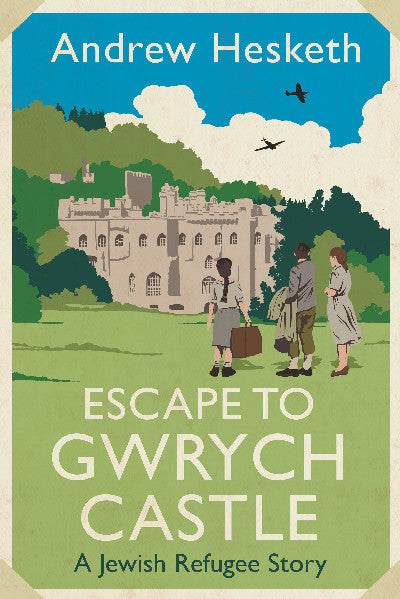
Gwrych Castle, near Abergele, Denbighshire, is a nineteenth-century folly built by Lloyd Hesketh Bamford-Hesketh (1787–1861), in memory of his mother Frances Lloyd and her ancestors. From 1894 until 1924, Winifred, Countess of Dundonald, the Hesketh heiress, owned the estate, and it became the residence of the Earls of Dundonald. The countess left the castle in her will to the royal family, who declined the gift, and the castle passed to the Order of St John, who had no real use for it. In 1928, and possibly in a fit of pique, the 12th Earl purchased the castle back for £78,000, but had no intention of living there. On his death in 1935, the castle passed to his son, the 13th Earl, who also showed no inclination to move into a dilapidated building, preferring instead to remain at his Scottish estate. The castle was then mothballed for many years, until it was used for a relatively unknown purpose from 1939 to 1941. Those who have heard of Gwrych Castle will probably associate it with the temporary location of the popular ITV reality show, I’m a Celebrity… Get Me Out of Here! , as the series was filmed there for two consecutive series, in 2020 and 2021, due to the fact that the usual Australian jungle location was unavailable because of Covid-19 restrictions. The ‘relatively unknown purpose’ mentioned above is the subject of this fascinating, very moving and meticulously researched book by Andrew Hesketh, which tells of the role the castle played in the government’s Kindertransport programme, when it was used to house 200 Jewish refugees. The centre was supervised by a Zionist movement which designated Gwrych Castle as one of many Hachshara, which literally means an agricultural training centre. The principal aims and objective of the centre were to prepare the refugees for eventual resettlement, when they would contribute to the establishment of a Jewish nation (Eretz Yisreal) in Palestine. The author provides a full account of the background of how the Jewish population was persecuted in Nazi Germany, and how the Kristallnacht pogrom finally persuaded many families to ensure that their children, at least, would survive by registering them for the Kindertransport initiative. The children who arrived at Gwrych were among the very last to leave Nazi Germany, and many of their parents subsequently perished in the concentration camps. The book deals with several aspects of their lives at Gwrych for the subsequent three years, including how they organised the Hachshara, and the practical difficulties they and their leaders encountered in adapting to life in a pretty basic environment with few facilities, whilst maintaining the Zionist educational ethos, as some refugees moved on when old enough to work and were replaced by less orthodox entrants. Their relationship with the local population is explored – a relationship which was often fraught with tension and suspicion because many had been designated as aliens by local tribunals. Conforming to the blackout regulations, in a building with so many windows, also proved problematic a few times! The narrative is supported by 495 footnotes, showing the extent of the research undertaken and including reference to a large number of oral interviews with Holocaust survivors undertaken by the British Library and the Imperial War Museum. All known residents of Gwrych Castle are listed, and the epilogue gives some indication of where those who survived ended up. Some, as noted, did not live to see the end of the war, whilst others lived to a good age in widely dispersed locations. The book includes a comprehensive index, 32 contemporary black and white photographs, and a beautiful cover illustration by artist David Wardle depicting three young refugees arriving at the castle.
Share