Cyngor Llyfrau Cymru
Last Respect, A — The Roland Mathias Prize Anthology of Contemporary Poetry
Last Respect, A — The Roland Mathias Prize Anthology of Contemporary Poetry
Couldn't load pickup availability
Disgrifiad Cymraeg / Welsh Description
Blodeugerdd hanfodol yn cynnwys detholiad hynod ddeniadol o gerddi gan 11 enillydd Gwobr Roland Mathias, ynghyd â thraethodau llawn gwybodaeth am Mathias, ac am farddoniaeth Gymraeg. Cynhwysir gwaith Dannie Abse, Tiffany Atkinson, Ruth Bidgood, Ailbhe Darcy, Rhian Edwards, Christine Evans, John Freeman, Philip Gross, Gwyneth Lewis, Robert Minhinnick ac Owen Sheers.
Disgrifiad Saesneg / English Description
A Last Respect is a must-have anthology: an irresistible selection of poems by the 11 Roland Mathias Prize winners, with informative essays about Mathias, and Welsh poetry. Includes work by Dannie Abse, Tiffany Atkinson, Ruth Bidgood, Ailbhe Darcy, Rhian Edwards, Christine Evans, John Freeman, Philip Gross, Gwyneth Lewis, Robert Minhinnick and Owen Sheers.
Manylion y cynnyrch / Product details
- ISBN 13
- 9781781726372
- Gwales Code
- gwales.com.9781781726372
- Gwerthwr / Vendor
- Cyngor Llyfrau Cymru
- Long Title
- Last Respect, A — The Roland Mathias Prize Anthology of Contemporary Poetry
- Sub Title
- The Roland Mathias Prize Anthology of Contemporary Poetry
- Awdur / Author
- Seren
- Current Price ex VAT
- £9.99
- Current Price inc VAT
- £9.99
- Availability Status (EN)
- Available
- Availability Status (CY)
- Ar gael
- Dyddiad cyhoeddi / Publication Date
- 2021-07-05
- Cyhoeddwr / Publisher
- Seren
- Editor
- Mathias, Glyn; Williams, Daniel G.
- Media Type (EN)
- Paperback / softback
- Media Type (CY)
- Clawr meddal
- Pages
- 160 pages
- Size
- 138 × 216 mm
- Language Code
- English
- Categori / Category
- CY: Barddoniaeth (yn Saesneg) | EN: Poetry (in English)
- Is-gategori / Subcategory
- CY: Blodeugerddi (yn Saesneg) | EN: Anthologies (in English)
Bywgraffiad yr Awdur / Author Biography
Glyn Mathias established the Roland Mathias Prize in honour of his father. He was a print and broadcast journalist with ITN and BBC Wales before becoming the Electoral Commission's Commissioner for Wales (2001-09). He is currently Chair of Offcom's Advisory Committee for Wales and a member of its Content Board. Professor Daniel G. Williams is Director of the Richard Burton Centre for the Study of Wales at Swansea University. He is the author of Wales Unchained: Literature, Politics and Identity in the American Century (2015), Black Skin, Blue Books: African Americans and Wales 1845-1945 (2012), and Ethnicity and Cultural Authority: from Arnold to Du Bois (2006). He was an adjudicator of the Roland Mathias Prize from 2009-11.
Adolygiad y Cyhoeddwr / Publisher Review
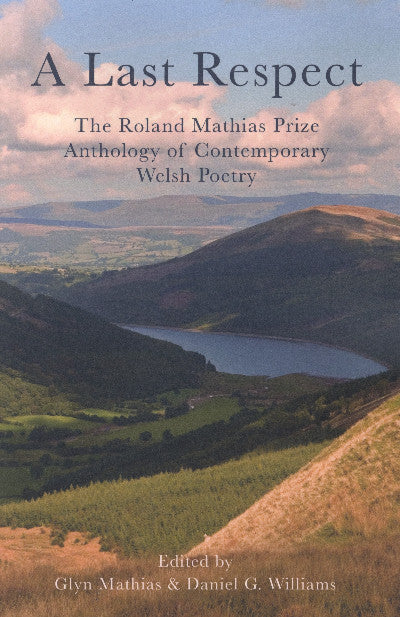
Since 2005 Roland Mathias has been synonymous with twenty-first-century poetry in Wales thanks to the Roland Mathias Prize: the annual award for Welsh poetry written in English established in his name. However, long before his son and co-editor of this anthology, Glyn Mathias, founded the award to honour him, Roland Mathias was a champion of ‘Anglo-Welsh’ poetry like no other. In her introductory essay to A Last Respect , Professor Jane Aaron paints a picture of the early twentieth century, when even icons of Anglo-Welsh literature like Dylan Thomas were dismissed. She quotes a 1938 lecture by poet and founder of Plaid Cymru, Saunders Lewis, in which he argues that, ‘Mr Thomas is obviously an equipped writer, but there is nothing hyphenated about him. He belongs to the English.’ It was in this environment, only four years later, that Mathias published his first poetry collection. He went on to publish much more throughout his life and, importantly, to edit The Anglo-Welsh Review , becoming a leading figure and well-respected critic and champion of Anglo-Welsh poetry. A Last Respect is an anthology of poetry by winners of the Roland Mathias Prize, book-ended with fascinating essays that contextualize what’s within. Aaron sets the scene and shares a biographical narrative of Mathias and the establishment of Anglo-Welsh literature, while the tail-end of the collection is home to an afterword by Daniel G. Williams, Mathias Junior’s co-editor of the collection. Williams’s essay is one that is very much worth reading and re-reading. In it, Williams explores the cultural criticism of Anglo-Welsh literature and looks at the links between art and place and the challenges of categorization. He quotes Ian Gregson’s argument that ‘the relationship between language and homeland […] is conspicuously denied the Welsh’ and explores comparative hyphenated literatures such as Prague-German and African-American, in which writers are both a part of and excluded from a minority culture. Looking through the biographies of the winners whose work makes up this collection it’s easy to see how the poets defy categorization. While all are either from Wales or live in Wales, their links are varied and subjective. Christine Evans, for example, was born in Yorkshire and was in her twenties before she moved to Wales. Her Welshness, Williams writes, is ‘elective’ and she ‘shares a sense of interiority and identification with a particular landscape’. Her poetry is considered, centred in a sense of place, and more than worthy of being the first winner of the Roland Mathias Prize. Elsewhere Wales and ‘Welshness’ are explored and ignored in equal parts. There is an extract from Owen Sheers’ ‘Taff’s Story’ which is a contemporary poem looking at war in Afghanistan from the dual perspective of a serving soldier and those he leaves back at home. His descriptive explanation of the term ‘pink mist’ is vivid and a world away from the bucolic rolling hills pictured on the cover of this book. ‘Bridgend’ by Rhian Edwards is another powerful piece. While unlike Sheers’ extract it is set entirely in Bridgend, south Wales, it similarly challenges the picturesque image of Wales one beholds on the cover. Southerndown beach is described in the context of its reputation as the ‘the third most popular suicide site in Britain. / Cliffs like headstones for giants!’ It’s hard to review an anthology without feeling as if those poets who remain unmentioned are being short-changed. However, in the case of A Last Respect , the fact that they are all award-winning writers tells you everything this reviewer hasn’t. There is a variety of styles and talents on show which all act as a testament to Roland Mathias’s life work as a champion of Anglo-Welsh literature. Who knows what Saunders Lewis would make of this book, but as an icon of Welsh literature and nationalism who was born outside Wales, on the Wirral in Merseyside, it’d surely be hard for Lewis not to acknowledge the impact of champions like Mathias on the establishment of Anglo-Welsh poetry. This collection is aptly named, acting as a last respect to Roland Mathias, with the winners in his name writing on as a creative and powerful legacy.
Share