Cyngor Llyfrau Cymru
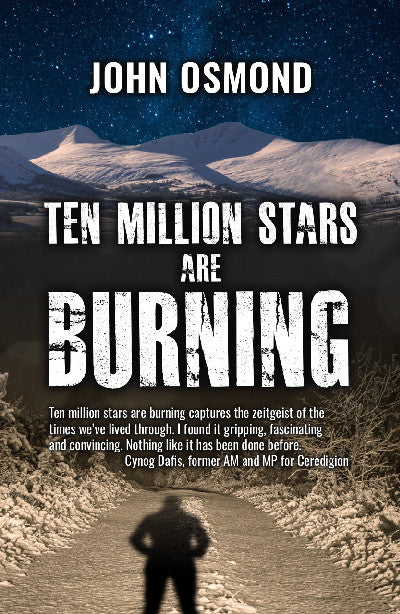
Ten Million Stars Are Burning
Ten Million Stars Are Burning
Couldn't load pickup availability
Disgrifiad Cymraeg / Welsh Description
Nofel ddogfen wedi'i gosod yn y 1970au sy'n adlewyrchu gwleidyddiaeth a diwylliant Cymru mewn cyfnod cyffrous a therfysglyd. Adroddir y stori drwy lygaid dau gymeriad sef Owen James, newyddiadurwr, a Rhiannon Jones-Davies, ymgyrchydd dros y Gymraeg, myfyrwraig a chynhyrchydd teledu yn ddiweddarach yn ei bywyd.
Disgrifiad Saesneg / English Description
Set in the 1970s, this documentary novel is set against the political and cultural events experienced in Wales during this tumultuous and exciting era. The story is told through the eyes of two fictional characters: Owen James, a journalist and Rhiannon Jones-Davies, a language activist, student, and later a television producer.
Dosbarthu
Byddwn yn dosbarthu eitemau sydd mewn stoc o fewn 3 diwrnod gwaith, fel arfer drwy Royal Mail Tracked 48. Ar gyfer archebion o flaen llaw, byddwn yn dosbarthu’r eitem o fewn 3 diwrnod gwaith ar ôl ei derbyn gan ein cyflenwr.
Dispatch
In-stock items will be dispatched within 3 business days, usually by Royal Mail Tracked 48. For pre-orders, we’ll dispatch within 3 business days of receiving the item from our supplier.
Manylion y cynnyrch / Product details
- ISBN 13
- 9781785622496
- Gwales Code
- gwales.com.9781785622496
- Gwerthwr / Vendor
- Cyngor Llyfrau Cymru
- Long Title
- Ten Million Stars Are Burning
- Awdur / Author
- Osmond, John
- Current Price ex VAT
- £11.99
- Current Price inc VAT
- £11.99
- Availability Status (EN)
- Available
- Availability Status (CY)
- Ar gael
- Dyddiad cyhoeddi / Publication Date
- 2018-03-14
- Cyhoeddwr / Publisher
- Gomer@Lolfa
- Media Type (EN)
- Paperback / softback
- Media Type (CY)
- Clawr meddal
- Pages
- 672 pages
- Size
- 128 × 169 mm
- Language Code
- English
- Categori / Category
- CY: Nofelau a Storïau ar Gyfer Oedolion (yn Saesneg) | EN: Adult Fiction and Stories (in English)
- Is-gategori / Subcategory
- CY: Ffuglen Lenyddol a Chyffredinol (yn Saesneg) | EN: General and Literary Fiction (in English)
Bywgraffiad yr Awdur / Author Biography
Newyddiadurwr ac ysgrifennwr yw John Osmond sydd wedi gweithio i bapurau newyddion a darlledwyr yng Nghymru ers dros 40 mlynedd. Mae wedi cyhoeddi sawl cyfrol am wleidyddiaeth a diwylliant Cymru. Mae bellach yn byw ym Mhenarth. Dyma ei nofel gyntaf.
Bywgraffiad yr Awdur / Author Biography
John Osmond is a writer and journalist, having worked for newspapers and broadcasters in Wales over the past four decades. In 1996 he was made the inaugural Director of the Institute of Welsh Affairs, a position he held for 17 years. He has published widely on Welsh culture and politics. John lives in Penarth and has three children. Ten Million Stars are Burning is his first work of fiction.
Adolygiad y Cyhoeddwr / Publisher Review
The author's note at the end of this historical novel describes its purpose as being to 'tell how the Welsh people struggled to come to terms with their identity during the last quarter of the twentieth century.' It is the first in a proposed trilogy of novels that aims to explore the facets of Welsh identity during the years when devolution to Wales was the subject of political and social debate and disagreement. This first instalment covers the years leading up to the 1979 devolution referendum, as experienced by the novel's two protagonists – the young student Rhiannon Jones-Davies and the journalist Owen James – in their interactions with politicians, poets, prisoners and parents. It is an epic work, and those who have an interest in the period, and in the antecedents of the 1997 devolution settlement, will recognise the political personalities of the time, and their involvement in and attitudes towards the referendum debates. The novel reminds us that the decisions of individuals are founded upon more than their political allegiances. They are as much determined by personal allegiances, friendships and experiences, by circumstances and society, as by the party line. It reminds us that we are influenced by those whose influences we do not see, and that those who may appear to be from one 'side' or other of the debate may in fact have less clear allegiances. It also reminds us that what happens on one day in history – in this case 1st March 1979, the date of the first Welsh devolution referendum – may have been shaped by seemingly inconsequential or unconnected events many years earlier; and this first volume sets the scene for the repercussions that the rejection of devolution in 1979 would have for Wales in the 1980s and 1990s. The fact that the setting of the novel takes place within Osmond's own lifetime and career as a journalist provides the perspective of a person who was there when the events of the novel unfold – the novel is part of the author's life and is in this sense autobiographical, in that the experiences of the characters and the matters that informed their perspective also played a significant part in the shaping of the author's own life story. He brings his journalistic meticulousness and detail into the novel; there is an exactitude in the preciseness of the context given. There is also a very specific sense of place – each chapter is set in a different but very specific place – and this creates a very real sense that Osmond's characters are treading on ground that will be familiar to those who will be interested in the novel's subject matter: Aberystwyth and the university, Cader Idris, Cledwyn Hughes's constituency office in Holyhead. Readers who know the history of devolution in Wales will enjoy the feeling they get, 'I've made that journey. I know that place. I've been there', when reading the novel, because these paths have now become pilgrimages – places the devolution historian will visit in order to understand why the Welsh political landscape now was trodden along by those who trod those paths then, including Owen and Rhiannon. They will also be familiar with the different types of Wales explored in the novel: the north, the south, the other, and Aberystwyth – that Aberystwyth of other-worldly intellectualism, public-house politics, and that crossroads where the south stops and the north begins. And there is a sense of relevance, that these stopping places from 1973 onwards are places where we must still stop. The novel is unashamedly political. Its very raison d'être is the political system and the political world, and the characters' tools are the political implements of the political party and the campaign group, breaking the law and operating within the law, political office and the power of enfranchisement. It is this political machine that gives the characters their motivations and the means of fulfilling their quest for self-definition. Readers with an interest in Wales's devolution story will look forward to the second and third instalments of this forty-five-year journey.
Share