Cyngor Llyfrau Cymru
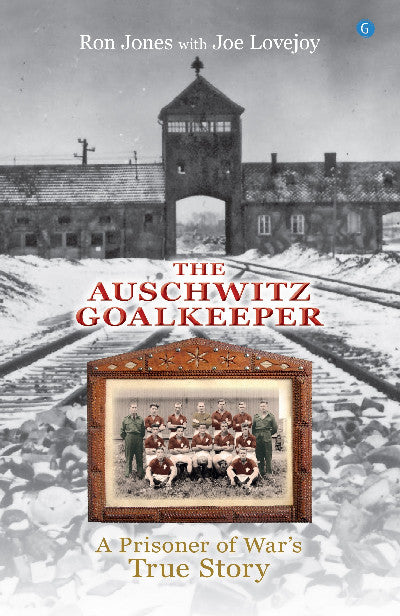
The Auschwitz Goalkeeper — A Prisoner of War's True Story
The Auschwitz Goalkeeper — A Prisoner of War's True Story
Couldn't load pickup availability
Disgrifiad Cymraeg / Welsh Description
Stori carcharor rhyfel o Gymro a ddioddefodd erchyllterau gwersyll marwolaeth mwyaf drwg-enwog y Natsïaid, ac yna cafodd ei orfodi'n greulon i orymdeithio ar draws Ewrop wrth i'r SS encilio o flaen y Rwsiaid oedd yn symud ymlaen. Daeth adref yn gysgod o'i gyn-hunan, gan ddweud. Gwelais bethau na fyddwn yn dymuno i'm gelyn gwaethaf eu gweld.
Disgrifiad Saesneg / English Description
Story of a Welsh POW who endured the horrors of the Nazis' most notorious death camp, and was then brutally forced to march across Europe as the SS retreated before the advancing Russians. He came home a shadow of his former self, saying. 2I witnessed things I wouldn't wish my worst enemy to see.
Dosbarthu
Byddwn yn dosbarthu eitemau sydd mewn stoc o fewn 3 diwrnod gwaith, fel arfer drwy Royal Mail Tracked 48. Ar gyfer archebion o flaen llaw, byddwn yn dosbarthu’r eitem o fewn 3 diwrnod gwaith ar ôl ei derbyn gan ein cyflenwr.
Dispatch
In-stock items will be dispatched within 3 business days, usually by Royal Mail Tracked 48. For pre-orders, we’ll dispatch within 3 business days of receiving the item from our supplier.
Manylion y cynnyrch / Product details
- ISBN 13
- 9781800997752
- Gwales Code
- gwales.com.9781800997752
- Gwerthwr / Vendor
- Cyngor Llyfrau Cymru
- Long Title
- The Auschwitz Goalkeeper — A Prisoner of War's True Story
- Sub Title
- A Prisoner of War's True Story
- Awdur / Author
- Jones, Ron; Lovejoy, Joe
- Current Price ex VAT
- £11.99
- Current Price inc VAT
- £11.99
- Availability Status (EN)
- Available
- Availability Status (CY)
- Ar gael
- Dyddiad cyhoeddi / Publication Date
- 2026-01-13
- Cyhoeddwr / Publisher
- Y Lolfa
- Media Type (EN)
- Paperback / softback
- Media Type (CY)
- Clawr meddal
- Pages
- 288 pages
- Size
- 140 × 215 mm; depth 22 mm
- Language Code
- English
- Categori / Category
- CY: Atgofion a Hunangofiannau (yn Saesneg) | EN: Autobiographies and Reminiscences (in English)
- Is-gategori / Subcategory
- CY: Atgofion a Hunangofiannau - Gwryw (yn Saesneg) | EN: Autobiographies and Reminiscences - Male (in English)
- FSC Status
- FSC certified (mixed sources) — C020637
Cynnwys / Table of Contents
Preface xi Foreword xv 1. "You're next" 1 2. You're in the Army Now 8 3. How it all Began 35 4. Welcome to Hell 42 5. The Auschwitz Cup 72 6. To Bomb or Not to Bomb 77 7. IG Farben and the Factory of Death 91 8. Auschwitz as Big Business 106 9. The End is Nigh 116 10. The Death March 121 11. Liberation Red Army Style 149 12. The Homecoming 154 13. Are You Sure? 172 14. The Culprits 200 15. The Testimony 212 16. Auschwitz Revisited 224 17. Unfinished business 229 Bibliography 248
Bywgraffiad yr Awdur / Author Biography
Ron Jones, who has passed away since this book was first published in hardback, was from Bassaleg, Newport. He was in a reserved occupation, as an engineer, at the start of the war, but was called up to join the Army due to an administrative error. Captured by the Germans in north Africa, he was a POW in Italy before ending up in Auschwitz. Joe Lovejoy has lived in Wales on and off for 30 years and has been a journalist for over 40 years, the last 30 with national newspapers in England. He was the chief football writer for the Sunday Times for 15 years and before that for The Independent. He is now semi-retired, but continues to freelance, mainly for The Guardian.
Adolygiad y Cyhoeddwr / Publisher Review
Ron Jones spent two years as a prisoner of war at Auschwitz, and was one of the many on the forced Death March as the Germans fled the advancing Russian army. They were on the road for seventeen weeks, walking 800 miles during one of the coldest winters on record. He never talked about his experiences until he was in his eighties. Now 96, Jones has worked with journalist Joe Lovejoy to produce a book that combines his own personal story with Lovejoy’s carefully researched historical account. Inevitably, The Auschwitz Goalkeeper is a shocking read, but Jones’s quiet, unembellished narrative eases the reader’s journey through the pages, while Lovejoy’s recounting of the facts embraces some of the less well-known aspects of the Auschwitz story. For instance, ‘it is a little-known fact, even today, that IG Farben, not the Nazi government, financed and was therefore responsible for Auschwitz and all its works, including Dr. Josef Mengele’s inhuman medical experiments’. IG Farben, a huge chemicals conglomerate, was still in existence in 2012, as a ‘corporation in liquidation’. In the 1930s, it was the largest company in Europe and the fourth largest in the world, and it payrolled the Nazis. Its Auschwitz plant produced synthetic rubber and fuel, and Zyklon B – the pesticide that was used in the gas chambers. The plant needed cheap labour, and guinea pigs for its research, both of which it purchased from the concentration camp on its doorstep. In turn, this arrangement provided the Nazis with much-needed funding for the continuing war effort. Auschwitz wasn’t just about a ghastly ideology and ‘the final solution to the Jewish question in Europe’, it was about money and big business and corporate power. Lovejoy also tackles the perhaps unanswerable question of whether the Allies should have bombed Auschwitz to disrupt, if not put an end to, the exterminations. They bombed the IG Farben factory next door to deprive the Nazis of fuel, but claimed fear of too much collateral damage if they targeted the gas chambers and crematoria. A US colonel is on record as saying, ‘we are over there to win the war, and not to take care of refugees’, while a British Foreign Office subordinate wrote, ‘in my opinion, a disproportionate amount of time at the Office is wasted on dealing with these wailing Jews’ – ‘wailing Jews’ whose only remains at Auschwitz were 368,820 men’s suits, 836,255 women’s coats and dresses, 44,000 pairs of shoes and 7.7 tons of human hair. In his preface, Jones promises to ‘tell it exactly as it was’ – ‘no exaggerations, no lies’. Facts like these need no embellishment. Suzy Ceulan Hughes (Review from www.gwales.com, with the permission of the Welsh Books Council)
Share