Cyngor Llyfrau Cymru
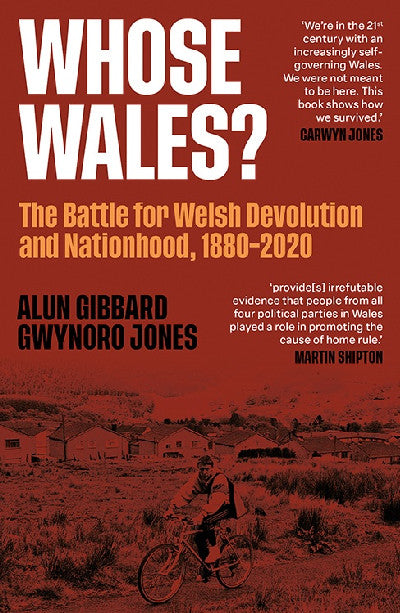
Whose Wales? — The Battle for Welsh Devolution and Nationhood 1880-2020
Whose Wales? — The Battle for Welsh Devolution and Nationhood 1880-2020
Couldn't load pickup availability
Disgrifiad Cymraeg / Welsh Description
Pwy biau Cymru? Mae rhywfaint o amwysedd ymhlyg yng ngwleidyddiaeth Cymru sydd, yn ei dro, wedi rhwystro trafodaethau sy'n adlewyrchiad o hunaniaeth wleidyddol Gymreig amlwg. A fedr un blaid hawlio iddi gyflawni mwy na'r un blaid arall yn y frwydr dros sicrhau a datblygu datganoli i Gymru? Mae'r llyfr hwn yn archwilio'r materion hyn.
Disgrifiad Saesneg / English Description
So whose Wales is it? There is a degree of ambiguity that runs through Welsh politics that in turn has hindered discussions of a clear Welsh political identity. Can any one party claim to have done more than any other in the fight for securing and developing Welsh devolution? This book looks at these claims and counterclaims.
Dosbarthu
Byddwn yn dosbarthu eitemau sydd mewn stoc o fewn 3 diwrnod gwaith, fel arfer drwy Royal Mail Tracked 48. Ar gyfer archebion o flaen llaw, byddwn yn dosbarthu’r eitem o fewn 3 diwrnod gwaith ar ôl ei derbyn gan ein cyflenwr.
Dispatch
In-stock items will be dispatched within 3 business days, usually by Royal Mail Tracked 48. For pre-orders, we’ll dispatch within 3 business days of receiving the item from our supplier.
Manylion y cynnyrch / Product details
- ISBN 13
- 9781917140706
- Gwales Code
- gwales.com.9781917140706
- Gwerthwr / Vendor
- Cyngor Llyfrau Cymru
- Long Title
- Whose Wales? — The Battle for Welsh Devolution and Nationhood 1880-2020
- Sub Title
- The Battle for Welsh Devolution and Nationhood 1880-2020
- Awdur / Author
- Jones, Gwynoro; Gibbard, Alun
- Current Price ex VAT
- £15.99
- Current Price inc VAT
- £15.99
- Availability Status (EN)
- Available
- Availability Status (CY)
- Ar gael
- Dyddiad cyhoeddi / Publication Date
- 2024-11-01
- Cyhoeddwr / Publisher
- Parthian Books
- Media Type (EN)
- Paperback / softback
- Media Type (CY)
- Clawr meddal
- Pages
- 460 pages
- Size
- 150 × 230 mm; depth 28 mm
- Language Code
- English
- Categori / Category
- CY: Hanes, Hanes Lleol, Arferion Gwlad, Llên Gwerin (yn Saesneg) | EN: History, Welsh Life and Customs, Local History, Folk Tales (in English)
- Is-gategori / Subcategory
- CY: Hanes - Arall (yn Saesneg) | EN: History - Other (in English)
- FSC Status
- No FSC or PEFC logo/certification declared
Bywgraffiad yr Awdur / Author Biography
Gwynoro Jones was twenty-seven years old when he was elected as the Labour MP for Carmarthen in 1970. It was the first of three elections he contested against Plaid Cymru leader Gwynfor Evans in the west Wales seat that became a touchstone for both nationalist and socialist ambitions for a new Wales. He was the first elected politician to address the European assembly (Council of Europe) through the Welsh language. A long political career of activism in favour of social democracy continues with his engagement initially in the early years of Yes Cymru but latterly with the efforts for greater Welsh sovereignty. Alun Gibbard is an award-winning writer with over forty books to his name. Two of his books have been short-listed for the British Sports Book Awards. His work is mainly non-fiction, with a strong social history narrative. He co-wrote the life-story of former First Minister Carwyn Jones. Prior to being an author, he worked in broadcasting, starting his career with BBC Wales News.
Adolygiad y Cyhoeddwr / Publisher Review
For anyone interested in Welsh politics, or indeed even a passing interest, this is a must read. Devolution and the Senedd is now a part of everyday life in Wales. However, reading the first chapters readers might be surprised to learn that as democracy developed during the nineteenth and early twentieth centuries, with a very few exceptions, Wales was all but ignored. Much of the political history of Wales, especially of the twentieth century, has invariably addressed the social and political issues of industrial Wales, concentrating on the growth of socialism, trades unions and the Labour Party. However, during the late eighteenth and much of the twentieth century, what is interesting is the extent to which Home Rule became and remained an issue, albeit varying in interest and support over time, but never quite going away. The various movements and individuals involved makes for interesting reading, not least the extent to which Home Rule was – on and off – an issue for leading members of the Labour Party. For those interested in the accidents of history, one section is particularly revealing. Lady Megan Lloyd George, the sitting MP for Carmarthen in 1966, was known to be seriously ill but the party decided to allow her to remain the party’s candidate for the 1966 general election. Her death a little while later led to the now famous Carmarthen by-election. And here is another twist; the local Labour Party chose the (relatively) weak and unknown Gwilym Prys Davies as candidate instead of the popular son of Cynwyl Elfed, Denzil Davies. Whilst not explicit, the narrative suggests that if the latter had been the candidate, the result would have been much different and the history of Wales, perhaps, would have been quite different. One consequence of the Carmarthen result was that many members of the Labour Party who favoured some form of Home Rule were regarded with suspicion by many other Labour Party members. These were to come to the fore during the 1979 referendum. Understandably, Jones spends some time describing the febrile atmosphere in Carmarthen and the bad blood of the 1970 and 1974 elections in what he calls the “Carmarthen Cauldron”. Gwynfor Evans – in Jones’ telling – was anything but the great man and did less work than his party propaganda suggested. There was palpable dislike, even hatred between the local parties, especially after the by election through the seventies and even into the eighties, especially with Plaid Cymru describing Gwynfor Evans as “the member for Wales” which he clearly wasn’t. Whether intentionally or not, the book makes a very strong case that devolution and the growth of Welsh democracy was driven not by Plaid Cymru, but by the Labour Party. A strong case is made that that it was Labour that carried the flag of Home Rule long before the Carmarthen by-election. An interesting insight presented by the book is that Plaid Cymru, it seems, has never actually been in favour of independence; moving between accepting very limited devolved power to Home Rule and Dominion Status. In many ways there is a sting here. Those of us working for Plaid Cymru then and after believed that the party’s leadership really was committed to independence, and although producing various material (I recall a leaflet on Dominion Status for Wales in the late 60s) this was in practice not taken seriously by many members. Although the book makes a fascinating read as to how we got here, it also provides an interesting insight into devolution today. In discussing the 1997 referendum, Jones points out that it was the late John Smith who was the driving force behind Labour’s commitment to devolution and that Tony Blair was unenthusiastic. This commitment and subsequent acceptance of the principal of devolution was perhaps the final step on the long tradition of Labour Party support for Home Rule. The book concludes with a look to the future – it ends with two well-argued articles, although each from a different direction. David Melding sees a UK federal future with significant devolution, the other by Glyndwr Cennydd Jones takes the idea even further, arguing for confederation, as close as it possible to be short of independence. Devolution and the democracy it represents is here to stay. Whether powers suggested by these two writers will come about, or indeed whether this is enough for the growing independence movement, remains to be seen. Another book maybe.
Share